THE SHORT ANSWER
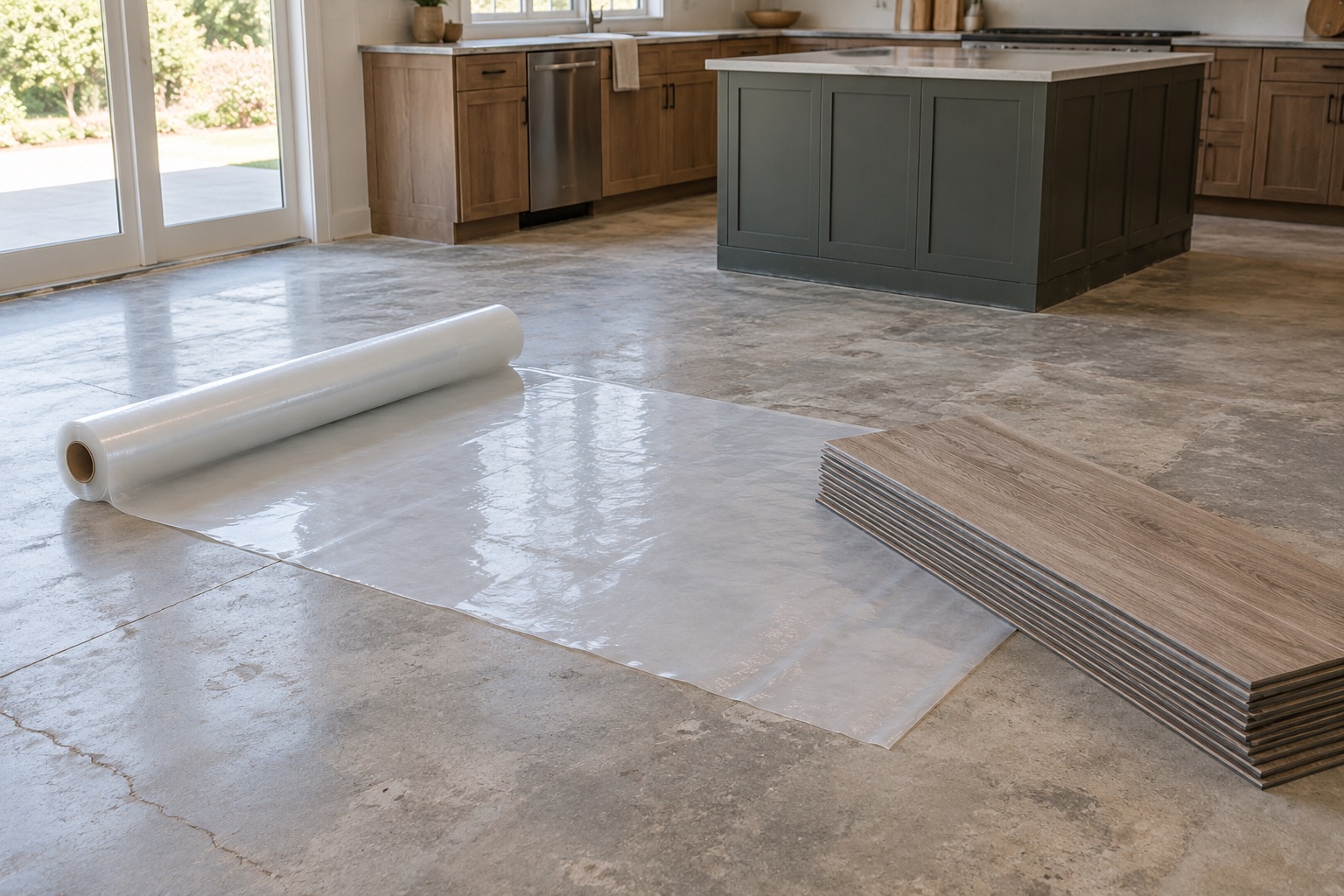
Use the moisture-control approach required by the exact flooring system after evaluating the slab. Vinyl's water resistance does not establish that concrete is dry or that the space has no leak. A sheet barrier may protect a floor under specified conditions, but it does not repair water entry, guarantee against mold or replace the manufacturer's moisture-testing requirements.
Separate the three questions hidden in this decision
Homeowners often ask whether they need plastic under vinyl when they are really asking three things: whether the product warranty requires it, whether moisture is entering the slab, and whether covering the concrete could create an unhealthy concealed condition. Those questions overlap, but one yes-or-no answer cannot resolve all of them.
In a Reddit account of mold beneath LVT, lifting a loose plank exposed a condition the owner had not noticed from above. Another discussion about a slab moisture barrier showed conflicting claims about trapped moisture. Neither account proves that all vinyl-on-concrete installations fail or that omitting a barrier is safer. They demonstrate why the source and quantity of moisture, the existing layers and the specified flooring assembly need to be identified before installation.
Identify the slab and the proposed assembly
Establish whether the slab is on grade, below grade or above another occupied space. Ask whether records show an under-slab vapor retarder, but do not treat its documented presence as proof of present conditions. Concrete age, recent wet work, past leaks, coatings and local water entry can affect the installation decision.
Write out the proposed layers. A floating plank with an attached pad and a sheet vapor retarder is different from a bonded floor over a moisture-mitigation system. Adhesives and primers introduce their own compatibility requirements. Existing coatings may affect adhesion or moisture testing. Do not add a generic pad because it is sold beside the flooring, and do not assume the pad attached to a plank performs every function of a specified vapor-control layer. Each layer needs a clear purpose and approval.
Get the product instructions before testing
The Shaw SPC guidance and COREtec Scratchless instructions illustrate that resilient products can specify substrate condition, testing and moisture-control details. Their limits and methods should not be mixed into a homemade specification. Find the current guide for the exact flooring model and installation method, including its exclusions for unsuitable conditions.
Have the installer explain which test method is required, where tests will be taken, what the results mean and what happens if the result is outside the permitted range. A handheld screening instrument or a piece of plastic taped to the slab is not automatically equivalent to the specified test. Keep the report, product identification and relevant environmental conditions. Testing is useful when it drives a decision; a number without its method, location or acceptance limit is difficult to interpret.
Investigate visible or historical water problems first
Standing water, recurring damp patches, unexplained odor or a history of flooding calls for investigation before covering the slab. A floor covering can conceal evidence and make later access more expensive. Find out whether the problem follows rain, plumbing use, seasonal conditions or a specific appliance. A qualified assessment may need to extend beyond the finish installer.
Do not select a surface-applied coating merely because someone used it successfully elsewhere. The material must be approved for the substrate, measured condition and covering system. Where a moisture-mitigation system is proposed, ask what preparation it requires and who warrants the complete assembly. There is a meaningful difference between managing permitted vapor transmission and trying to contain active liquid water. A successful flooring product elsewhere is not evidence that it can solve the water problem in your room.
Understand what a barrier can and cannot do
A specified sheet can reduce vapor reaching the floor covering when installed as part of an approved system. Its seams, edges and damage matter. That does not make the space beneath it biologically sterile, nor does it establish that the slab has stopped receiving moisture. Conversely, finding moisture beneath an impermeable covering does not by itself identify the original source.
Avoid simplistic advice that concrete must always breathe through the finished room or that more barriers always provide more protection. The assembly must be evaluated as a whole. Adding layers can introduce compatibility or cushioning problems, especially with a click floor. Ask the flooring manufacturer about ambiguous instructions before installation and retain its written response. The practical objective is a dry, serviceable installation under expected conditions, with known limits, rather than a debate over a material name.
If you discover mold under an existing floor
Stop treating the matter as a routine plank repair. Limit unnecessary disturbance and identify the moisture problem and affected materials. EPA's remodeling guidance emphasizes correcting moisture sources and avoiding exposure to microbial growth; it also distinguishes hard materials that may be cleaned from absorbent materials that may need replacement. The extent and conditions determine when specialist help is appropriate.
A bleach smell, a wiped surface or a newly laid barrier is not evidence that the whole assembly is ready to close. Consider the underside of the flooring, attached pad, wall edges and adjacent wood, not just the visible concrete. Document findings before disposal so the installer or assessor can understand the pattern. Do not use a Reddit photograph to diagnose the species, health impact or required remediation in your home.
Approve the installation with a complete record
Before laying planks, confirm that the selected system matches the assessed conditions and that required preparation is complete. Keep moisture results, photographs, manufacturer correspondence and the installed layer sequence. Inspect any sheet for proper treatment of seams and visible damage before it disappears beneath flooring.
For example, an installer who changes from a floating floor to a bonded system after testing must also revisit the adhesive, mitigation and preparation documents. The original plastic-sheet plan cannot simply carry over. At completion, retain leftover product and cleaning instructions, and establish what to do after a future leak. A moisture barrier is one component of the decision. The durable result comes from matching the product and installation method to the slab, then addressing conditions that neither can safely accommodate.
BEFORE YOU PROCEED
Your project checklist
- Identify slab location and previous moisture problems.
- Obtain the exact product's current installation guide.
- Record the full proposed layer sequence.
- Keep required moisture-test methods, locations and results.
- Resolve active water entry before installing flooring.
- Document mitigation compatibility and responsibility for the assembly.
Questions that come up next
Does an under-slab barrier eliminate testing?
Not automatically. Follow the flooring system's testing requirements and evaluate current slab conditions.
Should I add plastic under every vinyl floor?
No. Floating and bonded products differ; use the layer specified for the exact assembly rather than a universal rule.
EVIDENCE & SCOPE
Sources for this guide
Applies to: United States general material and workmanship guidance; selected-product instructions and applicable local requirements control.
Reddit discussions identify questions and experiences, not verified diagnoses or code requirements. Technical claims should be read with the linked primary source, product instructions and local requirements.
- COREtec Scratchless Installationmanufacturer
Subfloor flatness, moisture tests, expansion spacing, cabinet-specific glue-down exception. Installation details are specific to COREtec Scratchless, including its cabinet provisions.
- EPA: Indoor Air Quality Best Practices During Remodelinggovernment
Dust isolation, occupants, ventilation, cleanup and backdrafting limitations. General US indoor-air guidance; its ordinary ventilation approach does not cover lead-paint disturbance.
- Mold everywhere under LVT and vapor barrier.reddit
Mold found below floating flooring raises confusion about moisture sources and the purpose of a vapor retarder. Full thread text reviewed. This is an individual homeowner account.
- Moisture barrier over concrete?reddit
Owner worries that a recommended barrier will trap moisture and cause mold. Search excerpt reviewed; the full discussion was not available during research. This is an individual homeowner account.
- Shaw: Resilient Installation Guidelines for SPC Productsmanufacturer
Flatness, substrate condition and floating rigid-core installation. Indexed manufacturer installation guidance reviewed; numerical requirements are product-specific.