THE SHORT ANSWER
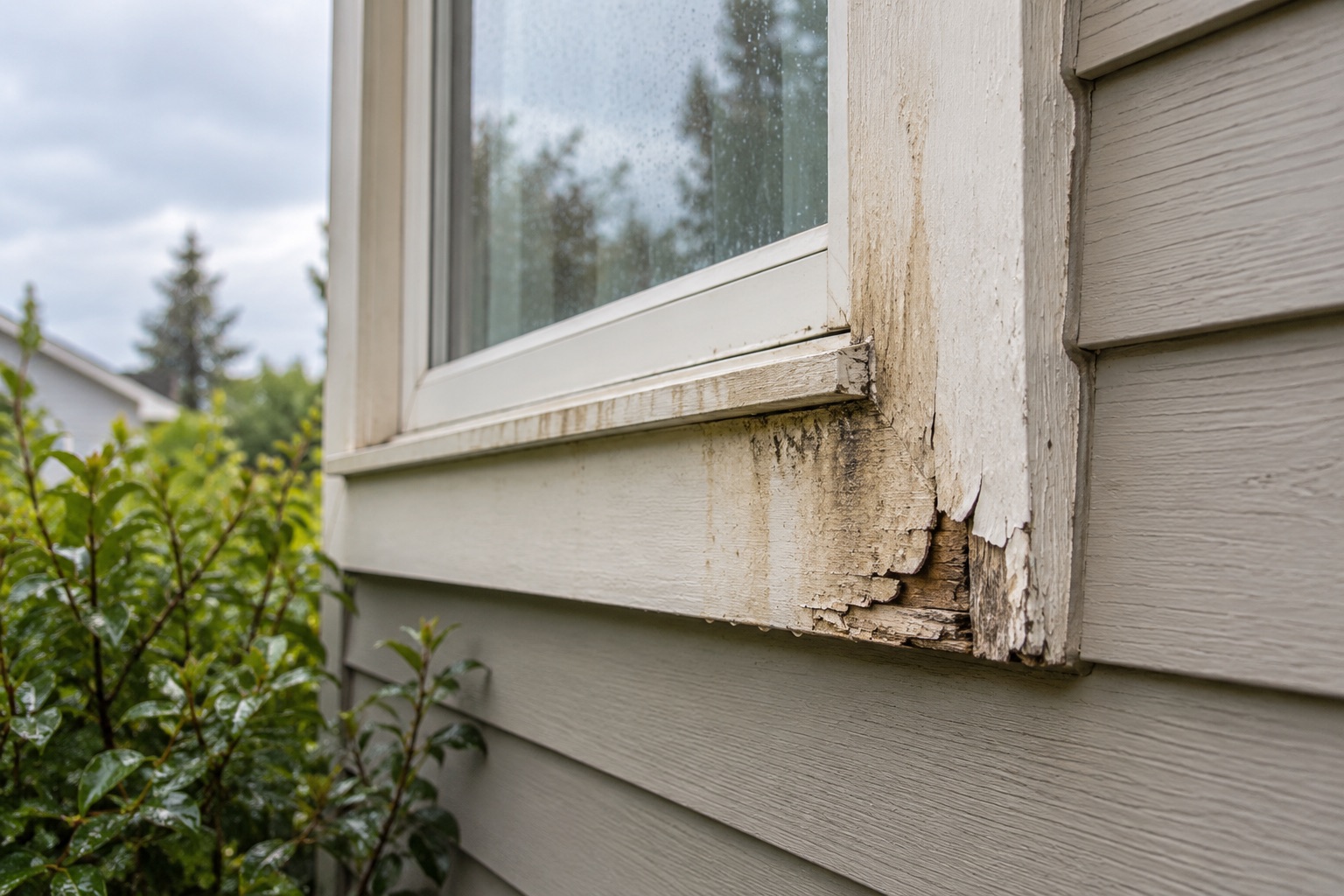
Exterior trim rot is a sign to investigate how the wood stays wet and what lies behind it. Replacing the visible board can leave damaged sheathing or framing concealed. A durable repair identifies the wetting mechanism, establishes the extent of deterioration, corrects the water-management detail, and selects replacement materials that fit the exposure and surrounding assembly.
Decide whether you are looking at trim or structure
A soft decorative board and a deteriorated structural member are different problems, even when they share the same painted surface. Exterior corners, window surrounds and garage openings can conceal sheathing, support framing and water-control layers. Before calling a repair cosmetic, identify what the visible piece does and which components it covers. A contractor may need limited access to answer that question reliably.
In one researched discussion, removing rotten garage trim exposed more deterioration and visible insulation behind it. The lesson is not that every trim defect requires extensive demolition. It is that the initial visible patch is an unreliable measure of the final repair scope. Allow for investigation rather than assuming either the best or worst case.
Follow the wetting mechanism
Look for patterns before choosing a replacement board. Repeated damage at the bottom of an opening can suggest splash, retained debris, poorly drained end grain or a failed interface. Damage higher on the wall can point toward a joint above. These are clues, not diagnoses. Record nearby gutters, roof intersections, irrigation and horizontal ledges that may concentrate water.
PNNL's roof-wall flashing guidance explains why water needs a continuous route away from susceptible assemblies. A new board does not create that route by itself. Ask the contractor to describe where rain goes after the repair, including water that passes behind the outer finish. “We will seal everything” is too vague to evaluate and can be wrong where drainage must remain open.
Understand what a rot finding can and cannot show
Discoloration, mold and decay should not be treated as interchangeable labels. Decay can reduce wood integrity; surface staining alone does not quantify that loss. The historical USDA Wood Handbook chapter on biodeterioration describes the relationship between organisms, wood and sustained moisture conditions. It is background science, not a field rule declaring every board safe below one meter reading.
Ask how the contractor will assess the remaining material and identify the boundary of deterioration. Photographs can document exposed conditions but cannot establish the strength of hidden framing. If the affected member carries load, the evaluation and repair need appropriate structural expertise. Cosmetic filler is not a substitute for restoring a required load path.
Define the first opening and the possible next scope
A useful proposal separates exploratory access from the repair that can already be priced. It names which trim will be removed, what the opening should reveal and how exposed areas will be protected from weather. It should also explain how the contractor reports additional damage and what approvals or design information are needed before reconstruction continues.
For a hypothetical example, a short rotten board beside a garage may hide only a small unprotected end, or it may cover wet sheathing extending beyond the visible stain. The same photograph could lead to either finding. A staged allowance is more honest than a firm claim that the repair is confined to the visible six inches, or a speculative recommendation to replace the entire wall.
Compare patching, board replacement and wider repair
A localized repair can make sense where the remaining substrate is sound, the component is nonstructural, and the moisture mechanism has been corrected. Whole-board replacement may simplify joints and finish matching. A wider repair is justified when adjacent layers are deteriorated or cannot be integrated properly through a small opening. Ask what evidence supports the chosen boundary.
Do not compare proposals only by the amount of visible trim replaced. One price may include water-control repairs and sheathing replacement while another covers only the outer board. Request separate descriptions of demolition, substrate work, flashing, replacement trim and paint. This makes a higher scope understandable and exposes an apparently inexpensive repair that omits the actual problem.
Choose the material as part of an assembly
Wood, cellular PVC and other trim products differ in movement, fastening, finishing and detailing. A less decay-prone outer material can reduce one maintenance burden, but it does not make the framing behind it immune to water. Product-specific clearances, joint treatment and fastening instructions still matter. Mixing materials also changes how joints move with temperature and moisture.
Ask the installer to identify the exact product, its permitted application and compatible coatings or sealants. Where adjacent boards will remain, decide how the transition will look and move. Matching an old dimension can be a legitimate carpentry issue; it should not become a reason to retain unsound material. Conversely, a small appearance mismatch does not by itself require replacing every board on the elevation.
Make concealment a deliberate decision
The HUD Residential Rehabilitation Inspection Guide is useful historical background for evaluating existing exterior and structural conditions. Its inspection approach reinforces a practical requirement: assess what is exposed before covering it. The document is not a current local code specification, and its age should be understood when it appears in a repair discussion.
Before closure, obtain photographs of the substrate, the water-control repair and any replacement framing or sheathing. Ask how retained wood was assessed and whether drying remains incomplete. Confirm that the intended joints and drainage paths were constructed rather than left to the painter. Finishing should follow correction of the substrate, not make an unresolved condition harder to observe.
Plan maintenance around the original failure
The final record should explain why this location deteriorated and what future observation would reveal recurrence. If a gutter overflow contributed, maintenance includes that drainage system. If landscaping concentrated irrigation against the wall, changing the trim alone is insufficient. If a product joint requires periodic inspection, include it in the home's maintenance notes with the product identification.
Check the repaired area after the next relevant wet-weather event and during routine exterior inspections. Look for new staining, failed joints or retained debris without damaging the finish or probing structural components yourself. The goal is not a promise that trim will never need attention again. It is a repair whose water-management logic is clear enough to inspect and maintain.
BEFORE YOU PROCEED
Your project checklist
- Identify whether affected wood is decorative, sheathing or structural.
- Document the likely water source and adjacent drainage conditions.
- Agree on staged access and documentation of concealed damage.
- Specify exact replacement products and installation instructions.
- Photograph substrate and flashing work before the trim conceals it.
- Tie future maintenance to the original wetting mechanism.
Questions that come up next
Will PVC trim prevent the rot from coming back?
It can avoid decay in the replacement trim itself, but water can still damage sheathing and framing behind it. The source and drainage detail need correction regardless of the outer material.
Can rotten trim be repaired with filler?
Sometimes a suitable product can repair a limited nonstructural defect in an otherwise sound assembly. It should not conceal continuing wetting, extensive deterioration or damage to a load-carrying member.
EVIDENCE & SCOPE
Sources for this guide
Applies to: United States homeowner education. Climate, existing assembly, manufacturer instructions and locally adopted requirements govern project details; no nationwide code threshold is asserted.
Reddit discussions identify questions and experiences, not verified diagnoses or code requirements. Technical claims should be read with the linked primary source, product instructions and local requirements.
- Flashing of Roof-Wall Intersections in Existing Homesgovernment
Roof-to-wall drainage and kick-out flashing as upstream sources of wall and window leaks. Technical guidance; local requirements and product-specific details vary.
- Wood Handbook - Chapter 13: Biodeterioration of Woodgovernment
Decay organisms, moisture conditions and distinction from superficial staining. Historical USDA Wood Handbook chapter. Direct retrieval was restricted; relevant text was available through search excerpts.
- Residential Rehabilitation Inspection Guidegovernment
Existing-building inspection, structural distress and hidden systems assessment. Historical HUD guide accepted in 2000; inspection background, not a statement of current local code.
- What to do about rot behind garage trimreddit
An anonymized homeowner question that informed the article. Retrieved through search excerpts; anecdotal evidence, not a technical diagnosis.
- How to Replace Rotting Wood Trim?reddit
An anonymized homeowner question that informed the article. Retrieved through search excerpts; anecdotal evidence, not a technical diagnosis.